
The Panagyurishte Gold Treasure: Bulgaria’s Golden Masterpiece
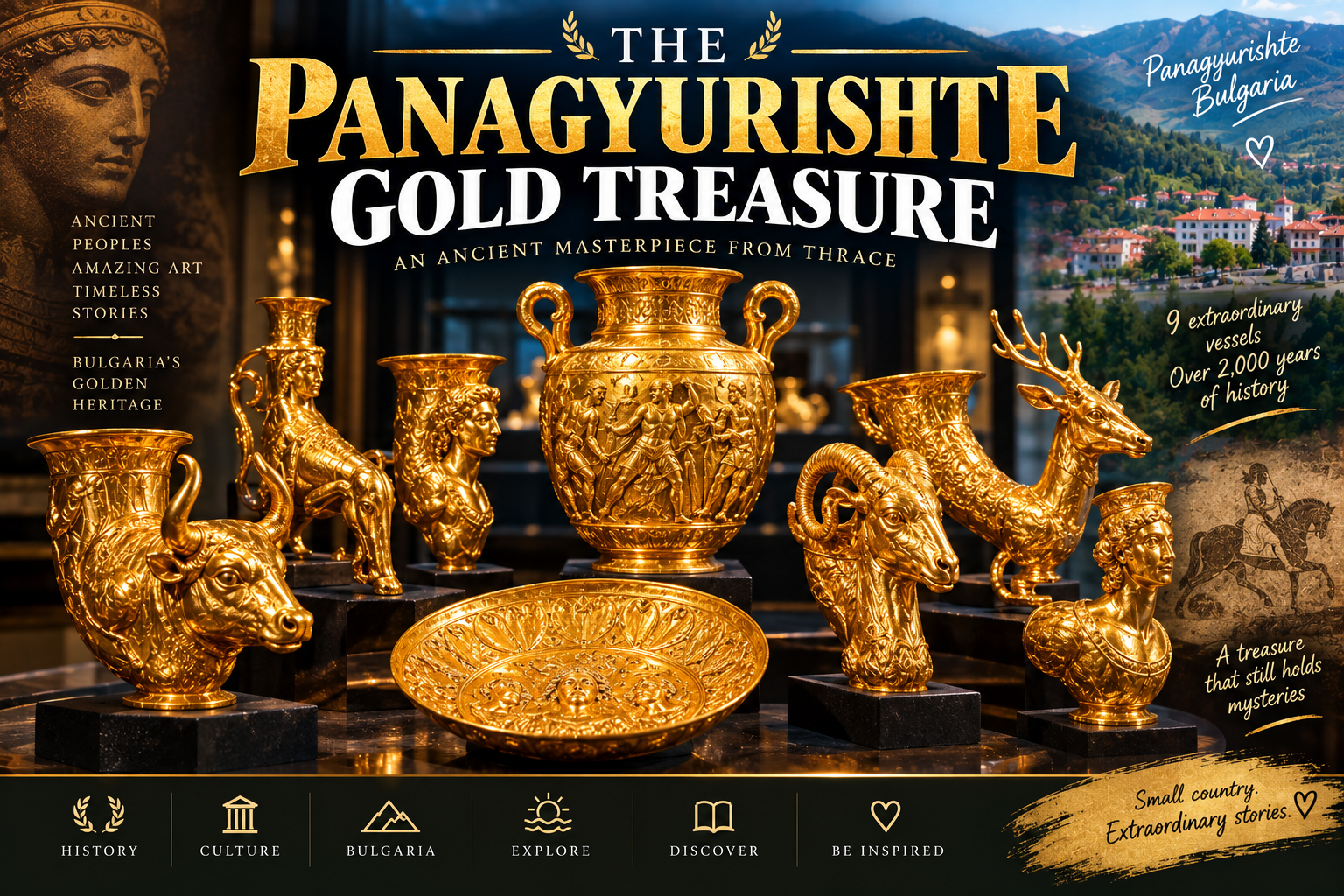
Panagyurishte Gold Treasure
Few archaeological discoveries capture the imagination quite like the Panagyurishte Gold Treasure. Found by chance in central Bulgaria in 1949, this extraordinary collection of nine golden vessels has become one of the most recognizable symbols of Bulgaria’s ancient Thracian heritage.
More than 2,000 years after it was created, the treasure still fascinates visitors with its incredible craftsmanship, detailed mythology and mysterious history.
But who made it? Who owned it? Why was it buried? And how did nine beautiful gold vessels survive underground for centuries?
Let’s discover the story behind one of Bulgaria’s greatest treasures.
What Is the Panagyurishte Gold Treasure?
The Panagyurishte Gold Treasure is a set of nine ancient gold vessels, created around the end of the 4th or beginning of the 3rd century BC.
The complete set weighs 6.164 kilograms and consists of a phiale, an amphora-rhyton and seven rhytons. The vessels are richly decorated with mythological scenes, animals, plants and human figures.
The treasure is generally associated with the Thracian world and is considered one of the masterpieces of ancient goldsmithing discovered in Bulgaria.
Its combination of Thracian, Greek and Achaemenid artistic influences makes it particularly interesting to historians and archaeologists.
1. It Was Discovered Completely by Accident
Perhaps the most remarkable part of the story is that nobody was searching for an ancient treasure.
On December 8, 1949, three brothers—Pavel, Petko and Mihail Deikov—were working near a former tile factory outside Panagyurishte.
They were digging clay when something unusual caught their attention.
Under the earth were golden vessels.
The brothers carefully removed the objects and eventually handed them over to the authorities. The local Historical Museum of Panagyurishte records that the brothers cleaned the treasure and delivered it to the state.
It was an extraordinary moment.
An ordinary day of physical work had suddenly turned into one of the most important archaeological discoveries in Bulgaria.
2. The Treasure Contains Nine Gold Vessels
The collection is made up of nine vessels.
There is:
- one phiale, or shallow ceremonial bowl;
- one amphora-rhyton;
- seven rhytons.
Together they weigh 6.164 kilograms.
The objects were not simple containers.
They were works of art.
Their surfaces are covered with elaborate relief decoration, including mythological characters, animals and scenes from ancient stories.
The craftsmanship is so detailed that even today visitors can spend a long time looking at individual figures and discovering new details.
3. It Is More Than 2,000 Years Old
The Panagyurishte Gold Treasure dates from approximately the late 4th to early 3rd century BC.
That places it in a fascinating period of ancient history.
Alexander the Great had recently transformed the political and cultural landscape of the eastern Mediterranean and Near East.
Greek artistic traditions were spreading across a vast territory, while local Thracian traditions continued to flourish.
The treasure reflects this interconnected ancient world.
It doesn’t belong neatly to just one artistic tradition.
Instead, it combines influences from different cultures.
4. The Decorations Tell Ancient Stories
One of the most fascinating aspects of the treasure is its decoration.
The goldsmiths didn’t simply make beautiful vessels.
They covered them with stories.
The objects contain scenes associated with Greek mythology, including figures such as Hera, Athena, Aphrodite, Apollo, Artemis and Nike. Other scenes depict heroes and mythological creatures.
For modern visitors, these scenes provide a fascinating connection to the ancient world.
Imagine attending a ceremonial gathering more than 2,000 years ago and seeing these golden vessels being used while stories about gods and heroes were told.
5. The Famous Rhytons Have Animal and Human Forms
The rhytons are among the most spectacular objects in the collection.
Several are shaped around the heads of animals or mythological figures.
There are rhytons associated with deer, a ram and a goat, while others incorporate human or mythological imagery.
One particularly famous rhyton features a deer head and includes scenes connected with the heroic stories of Theseus and Heracles.
Another depicts Paris seated between Hera, Athena and Aphrodite—the famous mythological judgment that ultimately leads to the events surrounding the Trojan War.
The artists managed to combine practical vessels with miniature sculptures and narrative scenes.
6. The Amphora-Rhyton Is the Largest Piece
The largest vessel in the treasure is the amphora-rhyton.
It weighs approximately 1.695 kilograms and is about 29 centimeters high.
Its decoration is especially impressive.
The vessel includes figures of armed men and a richly decorated architectural setting.
The scene has generated considerable scholarly interest because of its unusual composition.
Rather than simply being a container, the amphora-rhyton becomes almost like a miniature theatrical scene carved into gold.
7. The Phiale Is Covered With Intricate Decoration
Another remarkable object is the golden phiale.
This shallow bowl is decorated with repeated relief motifs, including human heads and plant ornaments.
The phiale also contains inscriptions relating to its weight and ancient units of measurement. BTA reports that two inscriptions give its weight in units associated with the ancient city of Lampsacus.
This makes the object particularly valuable to researchers.
It isn’t only beautiful—it also contains information that can help us understand the economic and cultural world in which it was produced.
8. Who Owned the Treasure?
This is one of the great mysteries.
The treasure is strongly associated with the Thracian elite, and it is often described as a royal or ceremonial set.
However, historians cannot identify its original owner with certainty.
One possibility is that it belonged to an important ruler or member of the Odrysian aristocracy.
The area around Panagyurishte was part of the ancient Thracian world, and the treasure dates to a period when powerful Thracian rulers controlled significant territory.
But there is no inscription saying:
“This belonged to King X.”
And that leaves room for debate.
9. Why Was It Buried?
Another mystery is why someone buried such an extraordinary collection.
The treasure was deliberately hidden underground.
But nobody left us an explanation.
Was its owner fleeing from an invading army?
Was the treasure hidden temporarily and never recovered?
Was it buried for ritual reasons?
Was it concealed during a period of political instability?
We simply don’t know.
That uncertainty is part of the treasure’s fascination.
We know where it was found.
We know roughly when it was created.
We can study its artistic style.
But the person who buried it never came back to tell us why.
10. It Shows the International Nature of the Ancient World
One of the most interesting things about the Panagyurishte Gold Treasure is that its artistic influences cross cultural boundaries.
The decoration combines Hellenic motifs and techniques with Thracian and Achaemenid traditions.
This tells us something important about the ancient world.
The civilizations of the Mediterranean and southeastern Europe were not isolated.
Ideas, artistic styles, luxury goods and technologies moved between regions.
The treasure is therefore evidence of a connected ancient world.
Was It Made in Thrace?
This question has been debated.
Some interpretations have suggested that the vessels were produced in Lampsacus, an ancient city in Asia Minor, because of the artistic characteristics and inscriptions associated with the treasure. Other interpretations have emphasized its Thracian context and ownership.
The exact place of manufacture remains a subject of scholarly discussion.
What is clear is that the treasure ended up in the territory of ancient Thrace and became part of the culture of the region.
That makes it an important part of Bulgaria’s archaeological heritage.
The Treasure and Thracian Culture
The ancient Thracians left behind no surviving literary tradition comparable to that of ancient Greece or Rome.
Much of what we know about them comes from archaeology and from accounts written by other ancient peoples.
This makes discoveries such as the Panagyurishte Treasure particularly valuable.
The vessels provide clues about:
- Thracian elite culture
- ceremonial traditions
- mythology
- artistic preferences
- contact with neighboring civilizations
- metalworking technology
- the importance of luxury objects
The treasure gives us a physical connection to a society that existed more than two millennia ago.
Where Can You See the Panagyurishte Gold Treasure?
The original vessels are part of the collection of the National Museum of History in Sofia, although the priceless objects are periodically exhibited elsewhere. Bulgaria’s Ministry of Tourism notes that the originals are held in Sofia and are also shown in traveling exhibitions.
The History Museum in Panagyurishte has a replica of the treasure for visitors when the originals are not on display there.
This is important because the original treasure requires extremely careful conservation and security.
The good news for travelers is that Panagyurishte itself remains an excellent destination for anyone interested in Bulgarian history.
When the Treasure Comes “Home”
There are special occasions when the original treasure returns to Panagyurishte.
In 2026, for example, the nine golden vessels were scheduled to be exhibited at the History Museum in Panagyurishte from April 1 to May 17, as part of celebrations marking 150 years since the April Uprising.
These temporary exhibitions are particularly exciting because they give visitors the opportunity to see the actual ancient objects close to where they were discovered.
For anyone planning a cultural trip through Bulgaria, it is worth checking current museum announcements before visiting.
Panagyurishte: A Town With a Remarkable History
The treasure is only one reason to visit Panagyurishte.
The town is also strongly connected with the April Uprising of 1876, one of the defining events in Bulgaria’s struggle for national liberation.
The local museum complex includes exhibitions dedicated to the uprising as well as the town’s crafts and history. Bulgaria’s Ministry of Tourism lists the History Museum as a year-round attraction with guided visits available.
This means visitors can combine two very different chapters of Bulgarian history:
Ancient Thrace and 19th-century Bulgaria.
Why Is the Panagyurishte Treasure So Important?
The Panagyurishte Gold Treasure isn’t valuable simply because it contains several kilograms of gold.
Its true value lies in what it tells us.
It reveals a world where:
Art was incredibly sophisticated.
Goldsmiths possessed remarkable technical skills.
Mythology was an important part of elite culture.
Different civilizations influenced one another.
Ceremonial objects could also be masterpieces of art.
And perhaps most importantly, it demonstrates the extraordinary cultural heritage that existed in the lands of modern Bulgaria more than 2,000 years ago.
A Treasure That Still Has Mysteries
Even after decades of archaeological research, important questions remain unanswered.
Who commissioned the vessels?
Who actually used them?
Were they produced for one ruler?
Why were they buried?
Why were they never recovered?
And exactly where were all nine vessels made?
Archaeology can provide clues, but some mysteries may never be solved.
Perhaps that’s what makes the Panagyurishte Gold Treasure so captivating.
We can see the gold.
We can see the craftsmanship.
We can study the mythology.
But we cannot hear the voices of the people who held these vessels more than 2,000 years ago.
Final Thoughts
The Panagyurishte Gold Treasure is one of Bulgaria’s greatest archaeological treasures and one of the most spectacular surviving examples of ancient Thracian luxury art.
Discovered by three brothers in 1949, the collection consists of nine beautifully decorated gold vessels weighing 6.164 kilograms. Created around the end of the 4th or beginning of the 3rd century BC, the objects combine Thracian, Hellenic and other artistic influences.
Today, the treasure is a symbol of Bulgaria’s ancient heritage.
But perhaps the most fascinating part isn’t the gold itself.
It’s the story behind it.
Someone created these magnificent vessels. Someone used them. Someone carried them across the ancient world. Someone eventually buried them—and for more than two thousand years, they waited beneath Bulgarian soil to be discovered again.
That is the real magic of the Panagyurishte Gold Treasure.

Tags


Recent Posts

The Nikola Vaptsarov House-Museum in Bansko – Where History Comes Alive

Къща-музей „Никола Вапцаров“ в Банско – мястото, където историята оживява
