
20 Amazing Facts About the Rila Mountain in Bulgaria
Rila Mountain
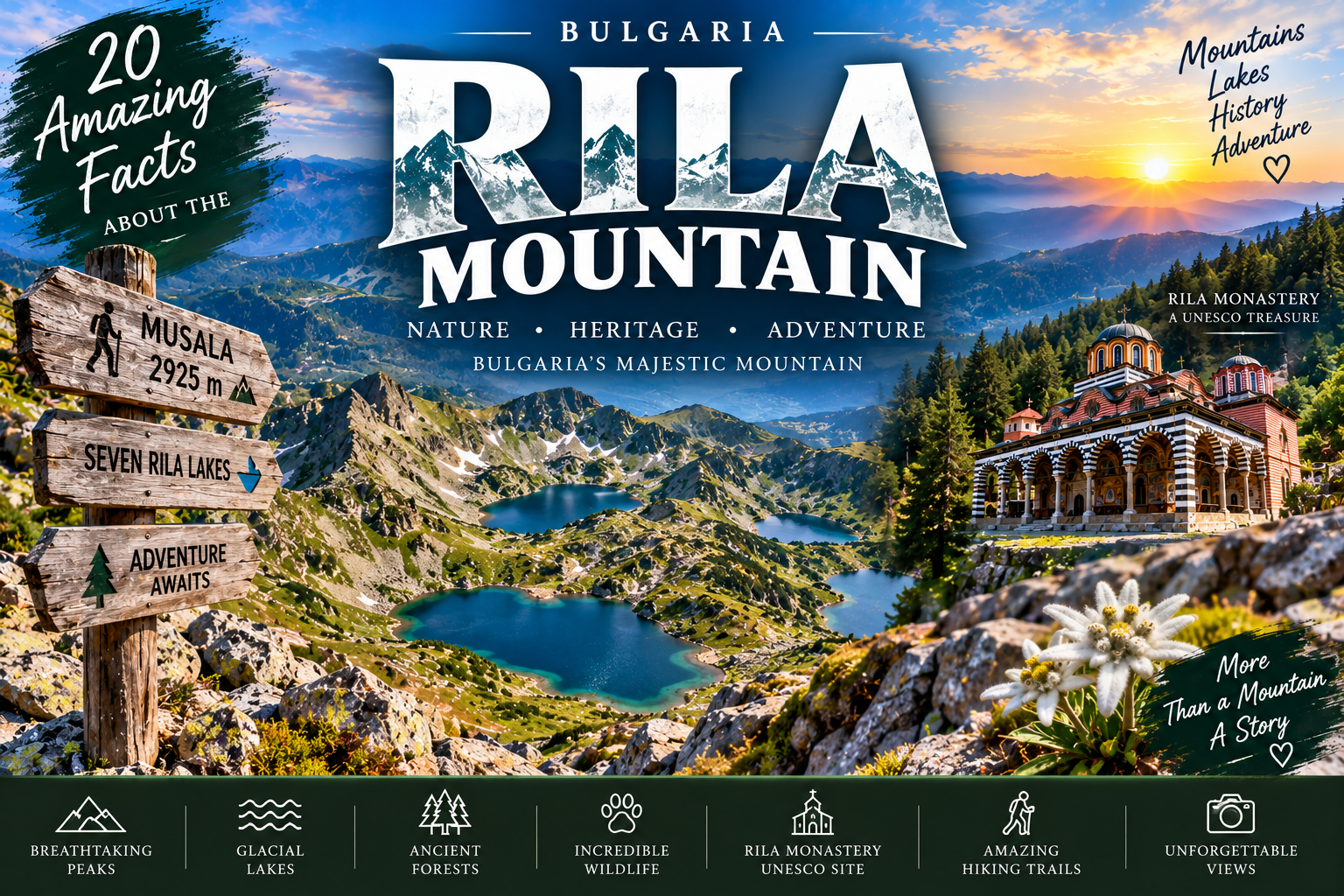
The Rila Mountain is one of Bulgaria’s greatest natural treasures. Home to the country’s highest peak, some of its most beautiful lakes, ancient forests and the famous Rila Monastery, Rila offers an extraordinary combination of nature, adventure, history and spirituality.
Located in southwestern Bulgaria, the mountain attracts hikers, climbers, photographers, wildlife lovers and travelers looking for a quieter side of the country.
From Musala Peak, the highest summit in Bulgaria and the Balkans, to the legendary Seven Rila Lakes, there is something remarkable around almost every corner.
Here are 20 amazing facts about the Rila Mountain.
1. Rila Is Bulgaria’s Highest Mountain
The first fact is also the most impressive.
Rila is home to Musala Peak, which reaches approximately 2,925 meters above sea level.
Musala is the highest mountain peak in Bulgaria and the entire Balkan Peninsula.
On a clear day, the views from the summit stretch across enormous parts of southwestern Bulgaria.
For mountain lovers, reaching Musala is one of the ultimate hiking experiences in the country.
2. Musala Is Higher Than Mount Olympus
Here’s a fact that surprises many visitors.
Musala is higher than Mount Olympus.
Musala reaches about 2,925 meters, while Mytikas, the highest summit of Mount Olympus in Greece, is approximately 2,918 meters.
The difference is small, but it means that the highest point in the Balkans is actually in Bulgaria.
This makes Rila particularly important to anyone interested in European mountain geography.
3. Rila Is Home to More Than One High Peak
Musala isn’t the only impressive summit in Rila.
The mountain contains numerous peaks rising above 2,500 meters.
Some notable summits include:
- Musala – 2,925 m
- Malka Musala – about 2,902 m
- Irechek – about 2,852 m
- Mancho – about 2,771 m
- Deno – about 2,790 m
This concentration of high peaks gives Rila a distinctly alpine character.
4. Rila Has Thousands of Years of Human History
People have lived around Rila for thousands of years.
The mountain’s valleys and surrounding areas have been used for agriculture, pastoralism, trade and religious life.
Later, Christianity became deeply connected with Rila through monasteries, hermit communities and religious traditions.
The most famous example is the Rila Monastery, which has stood as a spiritual center for centuries.
5. The Rila Monastery Is a UNESCO World Heritage Site
One of Bulgaria’s most famous landmarks is hidden in the mountains.
The Rila Monastery was founded in the 10th century by St. Ivan of Rila, Bulgaria’s most famous medieval hermit and saint.
The present monastery complex developed over centuries and became one of the most important centers of Bulgarian Orthodox culture.
In 1983, the Rila Monastery was added to the UNESCO World Heritage List.
Its colorful frescoes, architecture and mountain setting make it one of the country’s essential cultural attractions.
6. Rila Has the Famous Seven Rila Lakes
Perhaps the most photographed landscape in Rila is the Seven Rila Lakes.
The lakes form a spectacular chain in the northwestern part of the mountain.
Each lake has its own traditional name, including:
- The Tear
- The Eye
- The Kidney
- The Twins
- The Botanical Garden
- The Fish Lake
- The Lower Lake
They are connected by streams and waterfalls, creating one of Bulgaria’s most beautiful mountain landscapes.
7. The Eye Is the Deepest of the Seven Rila Lakes
One of the Seven Rila Lakes is particularly famous.
The Eye, also known as Okoto, is the deepest of the group.
It is famous for its distinctive oval shape and striking blue color.
When viewed from the surrounding slopes, the lake can resemble a giant eye surrounded by mountains.
It is one of the most iconic natural sights in Bulgaria.
8. Rila Was Shaped by Ancient Glaciers
Much of Rila’s spectacular landscape was created by glaciers during the Ice Ages.
Glacial activity carved valleys, cirques and basins into the mountain.
Many of the high-altitude lakes are remnants of these ancient glacial processes.
The result is the dramatic landscape we see today:
sharp ridges + deep valleys + rocky cirques + alpine lakes.
In some parts of Rila, the scenery looks more like the Alps than what many visitors expect from Bulgaria.
9. Rila Has Hundreds of Lakes
The Seven Rila Lakes are famous, but they are only a small part of Rila’s lake system.
The mountain contains many glacial lakes, particularly at higher elevations.
Some are large and easy to reach, while others are tiny and hidden among rocky valleys.
This abundance of mountain lakes gives Rila its distinctive character.
For photographers, the combination of clear water and dramatic peaks is especially spectacular in summer and early autumn.
10. Rila Is a Huge Source of Fresh Water
Rila is extremely important for Bulgaria’s water resources.
Numerous rivers and streams originate in or around the mountain.
The Iskar, Maritsa and Mesta river systems are associated with the Rila region.
The mountain’s snow and rainfall feed rivers that eventually flow toward very different parts of the Balkans.
In other words, Rila is not only beautiful—it plays a crucial role in Bulgaria’s natural water system.
11. Rila National Park Protects the Mountain
A large part of Rila is protected by Rila National Park.
Established in 1992, it is one of Bulgaria’s most important protected natural areas.
The park covers roughly 81,000 hectares and protects forests, alpine ecosystems, rivers, lakes and wildlife.
Its huge elevation range creates many different habitats.
Visitors can move from dense forests to treeless alpine landscapes within a relatively short distance.
12. Brown Bears Live in the Rila Region
Rila is home to a remarkable variety of wildlife.
One of the most famous inhabitants is the brown bear.
Other animals found in the wider Rila ecosystem include:
- wolves
- red deer
- roe deer
- wild boar
- chamois
- foxes
- golden eagles
Seeing large wildlife in the mountains is never guaranteed, but knowing that these animals inhabit the region adds another dimension to hiking in Rila.
Remember to keep your distance from wild animals and never feed them.
13. Rila Has Ancient Forests
The lower and middle elevations of Rila contain extensive forests.
Species include:
- Norway spruce
- fir
- Scots pine
- Macedonian pine
- beech
Some areas contain very old trees and relatively untouched forest ecosystems.
Walking through these forests before reaching the high alpine zone can be one of the most peaceful parts of a Rila hike.
14. Rila Has the Highest Alpine Environment in Bulgaria
Above the tree line, Rila changes dramatically.
Forests disappear and are replaced by:
- alpine grasslands
- rocky slopes
- exposed ridges
- mountain streams
- glacial formations
- high-altitude vegetation
This creates a landscape that feels completely different from the forests below.
The transition from forest to alpine terrain is one of the great pleasures of hiking in Rila.
15. Rila Is One of Bulgaria’s Best Hiking Destinations
Whether you’re an experienced mountaineer or a casual walker, Rila offers routes of many different difficulties.
Popular destinations include:
Musala Peak – for experienced hikers seeking Bulgaria’s highest summit.
Seven Rila Lakes – a spectacular and relatively accessible mountain excursion.
Malyovitsa – famous for dramatic rock scenery and mountaineering traditions.
Rila Monastery – ideal for combining culture and mountain scenery.
Urdini Lakes – a quieter alternative for hikers seeking solitude.
There are also countless smaller trails through forests and mountain valleys.
16. Malyovitsa Has a Special Place in Bulgarian Mountaineering
The Malyovitsa area is one of the country’s most famous mountaineering centers.
Malyovitsa Peak reaches approximately 2,729 meters.
Its distinctive rocky profile has attracted climbers and mountaineers for generations.
The area is particularly important in Bulgarian climbing history and remains a popular destination for hikers and climbers.
For those interested in the country’s mountaineering culture, Malyovitsa is a fascinating place to visit.
17. Rila Can Look Completely Different in Every Season
Rila isn’t a one-season destination.
Spring
Snow remains on the higher peaks while the lower forests begin turning green.
Summer
Mountain trails, lakes and alpine meadows become accessible and colorful.
Autumn
The forests turn golden, creating spectacular photography opportunities.
Winter
Rila becomes a snowy alpine landscape suitable for experienced winter hikers, ski touring and mountaineering.
Every season creates a completely different mountain.
18. The Mountain Can Be Wild Even When You’re Close to Sofia
One of Rila’s great advantages is its location.
It is relatively close to Sofia, Bulgaria’s capital.
This makes it possible to travel from an urban environment to a high-mountain landscape in a surprisingly short time.
Resorts such as Borovets provide access to the eastern part of Rila, while other roads and trails lead toward Malyovitsa, the Rila Monastery and other areas.
For travelers staying in Sofia, Rila can therefore be an excellent destination for a day trip or a longer mountain adventure.
19. Rila Is Connected With Bulgarian Spirituality
The mountain has an unusually strong spiritual identity.
The story of St. Ivan of Rila is central to Bulgarian Orthodox tradition.
According to tradition, Ivan lived as a hermit in the mountains during the 10th century.
His reputation for spiritual wisdom attracted followers, eventually leading to the development of the monastery that bears his name.
Today, the Rila Monastery remains an important pilgrimage destination.
This combination of wilderness and spirituality gives Rila a unique atmosphere.
20. Rila Is One of Bulgaria’s Greatest Natural Treasures
Perhaps the biggest fact of all is that Rila brings together an extraordinary number of Bulgaria’s natural and cultural highlights.
In one mountain region, you can find:
🏔️ The highest peak in Bulgaria
💧 Glacial mountain lakes
🌲 Ancient forests
🐻 Rare wildlife
🏞️ Protected national park
⛪ A UNESCO World Heritage monastery
🥾 Hundreds of kilometers of hiking opportunities
🧗 World-class mountain scenery
🌊 Important river sources
And that is why Rila deserves a place on almost every Bulgaria travel itinerary.
What Is the Best Time to Visit Rila?
For most visitors, June through September is the easiest period for hiking.
July and August are particularly popular because many high-altitude trails are usually accessible.
However, conditions can change quickly in the mountains.
Even in summer, hikers should carry warm and waterproof clothing.
If you want to see the Seven Rila Lakes, summer and early autumn offer some of the best opportunities.
For photographers, September and October can be spectacular because of the changing colors of the forests.
Winter should be approached much more carefully because snow, ice, avalanches and rapidly changing weather can create serious hazards.
How Difficult Are Rila’s Hiking Trails?
One of the best things about Rila is the variety.
You don’t need to climb Musala to experience the mountain.
There are easy walks around lower valleys, moderate hikes to mountain lakes and demanding ascents to high peaks.
For example:
| Destination | General difficulty | Typical experience |
|---|---|---|
| Seven Rila Lakes | Moderate | Lakes, meadows and panoramic views |
| Musala Peak | Moderate–Hard | High-altitude summit |
| Malyovitsa | Moderate–Hard | Rocky alpine terrain |
| Rila Monastery surroundings | Easy–Moderate | Culture and forest |
| High Rila winter routes | Advanced | Snow and alpine conditions |
Actual difficulty depends heavily on the season, weather, route and individual fitness.
Rila and the Rest of Bulgaria
One of the best ways to experience Rila is to combine it with Bulgaria’s other major mountain ranges.
From Rila, travelers can explore:
Pirin – famous for Vihren Peak and the Koncheto ridge.
Vitosha – located immediately south of Sofia and home to Cherni Vrah.
Rhodope Mountains – known for forests, villages, caves and spectacular scenery.
Balkan Mountains – stretching across much of central Bulgaria and home to Botev Peak.
Together, these mountains make Bulgaria one of the most interesting hiking destinations in southeastern Europe.
Final Thoughts
The Rila Mountain is much more than Bulgaria’s highest mountain range.
It is a place where dramatic alpine landscapes meet ancient forests, glacial lakes, wildlife and centuries of Bulgarian history.
You can stand on Musala, the highest peak in the Balkans, walk beside the turquoise waters of the Seven Rila Lakes, explore the forests of Rila National Park, or visit the magnificent Rila Monastery.
Few places in Bulgaria combine so many experiences in one destination.
And perhaps that is the greatest fact about Rila:
You don’t have to choose between adventure, nature, history and spirituality—you can experience all four in the same mountain.

Tags


Recent Posts
The Nikola Vaptsarov House-Museum in Bansko – Where History Comes Alive
Къща-музей „Никола Вапцаров“ в Банско – мястото, където историята оживява
