
The Nikola Vaptsarov House-Museum in Bansko – Where History Comes Alive
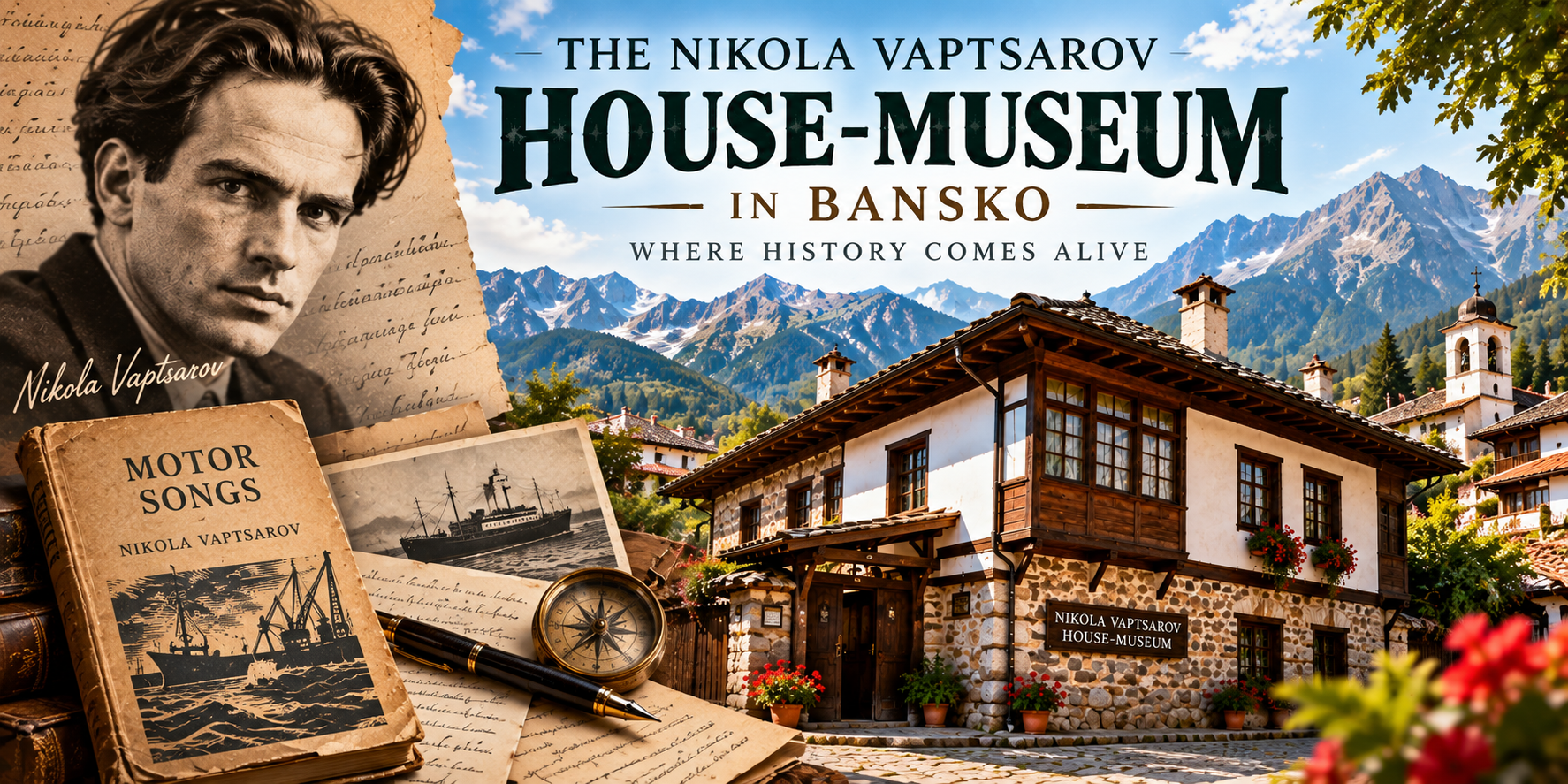
There are places in Bulgaria where history is not locked behind glass. You walk through an old door, touch the same wooden threshold that generations once crossed, and suddenly the past feels much closer.
The Nikola Vaptsarov House-Museum in Bansko is one of those places.
Located in the heart of Bansko, at Nikola Vaptsarov Square, the museum preserves the home and memories of one of Bulgaria’s most important poets of the 20th century. Nikola Vaptsarov was born in Bansko in 1909 and became known not only for his poetry, but also for his fascination with machines, technology, the sea, work, and the everyday lives of ordinary people.
Today, his childhood home tells a story that goes far beyond literature. It is a story about a family, a mountain town, a young man who dreamed of a different future, and a poet whose work continued to live long after his death.
Where is the Nikola Vaptsarov Museum?
The Nikola Vaptsarov House-Museum is located at Nikola Vaptsarov Square No. 3 in Bansko, close to the historic center of the town.
Bansko is already famous for its stone-and-wood houses, narrow streets, traditional architecture, and spectacular location at the foot of the Pirin Mountains. But among the many historic buildings in the town, Vaptsarov’s home has a special place.
This is not simply a museum dedicated to a famous Bulgarian writer. It is the actual house where Nikola Vaptsarov spent his childhood.
That difference matters.
When you enter the building, you are not simply looking at an exhibition about someone who lived more than a century ago. You are stepping into the environment in which the future poet grew up.
The house itself is part of the story.
Its traditional architecture reflects the character of old Bansko, where stone, timber, enclosed courtyards, and practical household spaces were part of everyday life. The surrounding town has changed considerably over the years, but the museum preserves an important connection with the Bansko of Vaptsarov’s childhood.
A house that became a museum
The house was officially opened as a museum in 1952.
This was an important moment for Bansko’s cultural history because the museum became one of the earliest institutions of its kind in the Pirin region. Over the decades, the building developed into a place where visitors could learn not only about Nikola Vaptsarov’s poetry, but also about his family, education, interests, and short but remarkable life.
One of the interesting parts of the museum’s history is the role played by Vaptsarov’s family.
His mother, Elena Vaptsarova, and his sister Raina were among the first people involved in welcoming visitors. Elena also played an important role in reconstructing the atmosphere of the family home.
That gives the museum an unusually personal character.
Many museums contain objects that once belonged to famous people. Here, however, the exhibition attempts to recreate the surroundings in which the poet actually lived.
A major rearrangement of the exhibition was completed in 1992, under the direction of Bulgarian filmmaker and director Vulo Radev and his team.
The result is a museum that combines the atmosphere of a traditional Bansko home with documentary material about Vaptsarov’s life and work.
What can you see inside the museum?
The museum occupies two floors and includes reconstructed rooms and exhibition spaces.
Visitors can see elements of the family home, including the living room, guest room, and the study associated with Elena Vaptsarova.
The rooms help explain what daily life looked like for the family at the beginning of the 20th century.
There are photographs, documents, personal belongings, books, certificates, and other objects connected with Vaptsarov and his family.
Some of these objects are particularly interesting because they are not spectacular in the traditional museum sense. A certificate, an old notebook, a family photograph, or a personal document can seem ordinary at first glance.
But together they create something much more valuable: a picture of a real person.
Instead of seeing Vaptsarov only as the name of a poet in a Bulgarian literature textbook, visitors can begin to understand the young man behind the name.
He was a son, a student, a worker, a person fascinated by technology, and someone trying to understand a rapidly changing world.
Nikola Vaptsarov – the poet who loved machines
One of the most fascinating aspects of Vaptsarov’s story is the combination of poetry and technology.
Today, we often imagine poets as people who live primarily in the world of books, emotions, and imagination. Vaptsarov was different.
He was deeply interested in machines and industrial technology.
He studied at the Naval Machinery School in Varna, an experience that had a lasting influence on him. He later worked with machinery and spent time in industrial environments.
This connection between man and machine appears repeatedly in his poetry.
For Vaptsarov, the machine was not simply a piece of metal. It represented work, progress, human ambition, and sometimes the difficult relationship between people and the industrial world.
That is one reason his poetry remains distinctive.
He could write about engines, factories, workers, ships, and technology while still focusing on very human subjects such as hope, suffering, love, dreams, and the desire for a better life.
“Motor Songs” and the world of Vaptsarov
One of the most important works associated with Nikola Vaptsarov is “Motor Songs” (Motorni Pesni).
The collection was published in 1940 and became central to his literary legacy.
The title itself tells us something about Vaptsarov’s unique approach. “Motor songs” sounds almost contradictory. A motor belongs to the world of machines, noise, fuel, and industrial production. A song belongs to poetry and emotion.
Vaptsarov brought these worlds together.
His poems often speak about ordinary people rather than distant heroes. Workers, sailors, engineers, and people struggling with everyday life appear in a world where machines and human beings exist side by side.
The museum preserves material connected with Motor Songs, allowing visitors to see the literary side of Vaptsarov’s life alongside the physical environment in which he grew up.
For anyone interested in Bulgarian literature, this is one of the most meaningful parts of the visit.
From Bansko to the sea
At first glance, Bansko and the sea may seem like two completely different worlds.
Bansko is a mountain town surrounded by Pirin. Its traditional culture developed in a completely different environment from Bulgaria’s coastal cities.
Yet the sea became an important part of Nikola Vaptsarov’s life.
His studies in Varna and his work connected him with ships, machinery, and the maritime world. This experience expanded his horizons far beyond his mountain hometown.
It is interesting to think about the contrast.
A boy growing up among the stone houses and mountain landscapes of Bansko eventually became fascinated by engines, ships, and the industrial world.
That contrast is one of the things that makes his story so memorable.
The museum in Bansko therefore represents only the beginning of a much larger journey.
The house tells us where he came from. His later life shows where his interests and ambitions took him.
Personal documents and objects
One of the strengths of the museum is the collection of original and documentary material.
Among the objects and documents associated with the exhibition are Vaptsarov’s baptism certificate, education certificates, photographs, family documents, notebooks, and other personal items.
There is also a personal seal associated with Peyo Yavorov, one of Bulgaria’s major poets, as well as an old merchant ledger.
A particularly touching object is a notebook given to Nikola by his mother.
Objects like these may appear small compared with the larger historical story, but they create an intimate connection with the past.
A photograph shows a face.
A certificate tells us where someone studied.
A notebook can reveal a relationship.
A personal object can remind us that historical figures were once young people living ordinary lives, surrounded by families and everyday concerns.
This is precisely why a house museum can sometimes tell a different story from a conventional museum.
Elena Vaptsarova – the mother behind the story
It is impossible to understand the museum without mentioning Elena Vaptsarova, Nikola’s mother.
She played an important role in preserving the memory of her son and in helping reconstruct the family environment that visitors can see today.
Her involvement gives the museum another human dimension.
The story is not only about the poet himself. It is also about the family that surrounded him.
For visitors, this is particularly interesting because the reconstructed rooms are not merely decorative. They are intended to communicate something about the household in which Vaptsarov grew up.
Family photographs, furniture, documents, and personal possessions help create a sense of everyday life.
In a world dominated by digital photographs and constantly changing surroundings, there is something powerful about seeing an actual physical space that has been preserved for generations.
Why the museum matters to Bansko
Bansko is internationally known today as a mountain destination and ski resort. Visitors come for Pirin National Park, winter sports, hiking, traditional food, festivals, and the town’s historic atmosphere.
But Bansko is much more than a tourist destination.
Its history has produced musicians, artists, writers, craftsmen, teachers, and other notable figures. The Nikola Vaptsarov House-Museum is an important part of that cultural identity.
Visiting the museum adds another layer to a trip to Bansko.
After walking through the old streets and seeing traditional stone houses, you begin to understand the environment from which Vaptsarov came.
The museum also provides an interesting contrast with the modern image of Bansko.
Today, the town has hotels, restaurants, ski facilities, cafés, and visitors from all over the world. Inside the museum, however, the pace becomes slower.
You are reminded of a very different Bansko.
A Bansko of family homes, handwritten documents, traditional household life, and young people dreaming about what might exist beyond the mountains.
A visit for more than literature lovers
You do not need to be a specialist in Bulgarian poetry to enjoy the museum.
In fact, the museum can be interesting for several different types of visitors.
History enthusiasts can explore documents and personal objects from the first half of the 20th century.
Architecture lovers can experience a traditional Bansko house.
Literature fans can learn more about one of Bulgaria’s best-known poets.
Families can use the museum as a way to introduce children to Bulgarian history and culture.
And travelers visiting Bansko can discover a side of the town that is easy to miss when the focus is only on skiing, restaurants, and mountain activities.
The museum is especially worthwhile if you want to understand why Bansko is considered an important cultural center in southwestern Bulgaria.
Practical information
The museum is located at:
Nikola Vaptsarov Square No. 3, Bansko, Bulgaria
The official museum information lists opening hours generally as:
- Weekdays: 09:00–13:00 and 14:00–17:30
- Weekends and public holidays: 09:00–13:00 and 14:00–17:00
Opening times can change depending on the season or holidays, so it is sensible to check before visiting.
The museum also offers guided presentations.
The current published ticket information includes approximately:
- Adults – €3
- Students and pensioners – €2
- Visitors with disabilities – €1
- Family ticket – €5
- Guided presentation – approximately €5
For current information, visitors can contact the museum directly at +359 749 83132 or by email at mk_bansko@mail.bg.
The museum and the spirit of Pirin
There is something particularly appropriate about having Nikola Vaptsarov’s museum in Bansko.
The Pirin Mountains dominate the landscape around the town. They create a feeling of permanence, while Vaptsarov’s life represents movement and change.
He grew up in a traditional mountain environment but became fascinated by machines, industry, ships, and the modern world.
His poetry brought together things that might initially appear unrelated: mountains and factories, people and machines, dreams and reality, work and freedom.
That mixture is part of what makes his story so interesting.
You can almost imagine the young Vaptsarov walking through the streets of Bansko, surrounded by the traditions of his hometown while thinking about the world beyond it.
Later, his life would take him to Varna and into the world of machinery and maritime technology.
But the starting point remained this house.
A different way to experience Bansko
A visit to the Nikola Vaptsarov House-Museum can easily be combined with a walk through Bansko’s historic center.
Take your time.
Look at the old houses, stone walls, wooden balconies, small courtyards, churches, and narrow streets. Then enter the museum and see how one family lived in this environment more than a century ago.
It creates a different experience from simply taking photographs of Bansko.
You begin to see the town as a place where real people lived, worked, studied, argued, dreamed, and planned their futures.
And that is perhaps the greatest value of a house museum.
It gives history a human scale.
Final thoughts
The Nikola Vaptsarov House-Museum in Bansko is more than a memorial to a famous Bulgarian poet.
It is a preserved piece of Bansko’s history and a window into the life of a remarkable young Bulgarian who stood between two worlds – the traditional world of his mountain hometown and the rapidly changing industrial world of the 20th century.
Inside the museum, visitors can discover his family environment, personal documents, photographs, educational records, literary works, and objects connected with his life.
But perhaps the most important thing is the feeling of place.
This is where Nikola Vaptsarov grew up.
This is where his story began.
And when you leave the museum and step back into the streets of Bansko, the old town can look slightly different. The stone houses and wooden balconies are no longer simply beautiful examples of Bulgarian architecture. They become part of a living historical landscape.
For anyone visiting Bansko and looking for something beyond skiing, hiking, restaurants, and mountain views, the Nikola Vaptsarov House-Museum is a worthwhile stop.
It is a place where literature meets history, where the mountains meet the memory of a poet, and where a simple family home continues to tell a story more than a century after its youngest generation first walked through its doors.

Tags


Recent Posts
The Nikola Vaptsarov House-Museum in Bansko – Where History Comes Alive
Къща-музей „Никола Вапцаров“ в Банско – мястото, където историята оживява
