
20 Amazing Facts About Musala Peak in Bulgaria
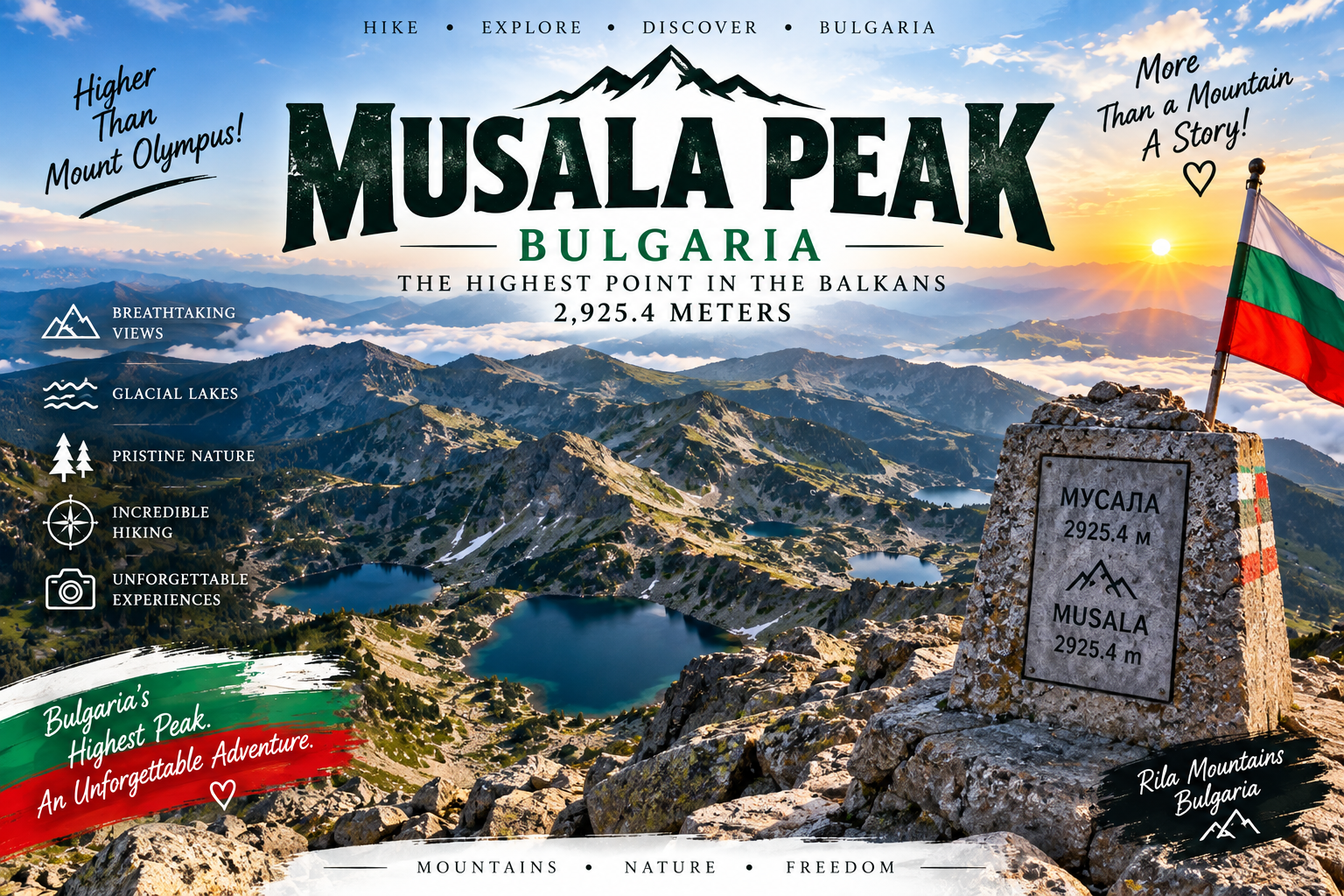
Musala Peak Bulgaria
High above the forests of southwestern Bulgaria rises Musala Peak, a spectacular summit in the Rila Mountains. At 2,925.4 meters, Musala is not only the highest mountain in Bulgaria—it is the highest peak on the entire Balkan Peninsula.
For hikers, photographers, nature lovers and anyone fascinated by Bulgaria’s mountains, Musala is one of the country’s most impressive destinations.
But there is much more to Musala than its height. From ancient name origins and glacial lakes to scientific research and spectacular views, the mountain has an extraordinary story.
Here are 20 amazing facts about Musala Peak.
1. Musala Is the Highest Peak in Bulgaria
Let’s start with the most obvious—and most impressive—fact.
Musala reaches 2,925.4 meters above sea level.
That makes it the highest point in Bulgaria. It is also the highest summit anywhere on the Balkan Peninsula.
For comparison, Bulgaria’s second-highest peak, Vihren in Pirin, reaches about 2,914 meters.
So Musala is only around 11 meters higher than Vihren, but that is enough to give it the title of Bulgaria’s highest mountain.
2. It Is Higher Than Mount Olympus
Many people know Mount Olympus in Greece as the legendary home of the ancient Greek gods.
But Bulgaria’s Musala is actually higher.
The highest summit of Olympus, Mytikas, is about 2,918 meters high, while Musala reaches 2,925.4 meters.
That means Musala rises several meters above the famous Greek mountain.
It is one of the fun facts that surprises many travelers.
The highest mountain in the Balkans is in Bulgaria—not Greece.
3. Musala Is in the Rila Mountains
Musala isn’t an isolated mountain.
It is part of Rila, Bulgaria’s highest mountain range.
Rila is located in southwestern Bulgaria and contains numerous peaks above 2,000 meters. The highest part of the range has an unmistakably alpine character, with rocky ridges, glacial lakes and high-altitude valleys.
The eastern part of Rila, where Musala is located, is sometimes known as Musala Rila.
4. The Name Musala Has a Fascinating Origin
The name Musala is believed to come through Ottoman Turkish from the Arabic word musalla.
Bulgaria Facts for Kids: 25 Amazing Things to Discover About Bulgaria
It is associated with meanings such as “place for prayer” or “near God.”
It is an appropriate name for such an enormous mountain.
Standing nearly three kilometers above sea level, surrounded by clouds, rock and alpine landscapes, it is easy to understand why mountains have inspired spiritual associations throughout history.
5. Musala Is Inside Rila National Park
Musala is located within Rila National Park, one of Bulgaria’s most important protected natural areas.
The park covers approximately 810 square kilometers and protects a huge variety of mountain ecosystems. Its elevation ranges from around 800 meters to Musala’s summit at 2,925 meters.
This means that a journey through Rila National Park can take you through dramatically different environments—from forests to high alpine terrain.
6. You Can Reach Musala in a Single Day
One reason Musala is so popular is that it is relatively accessible for such a high summit.
The classic approach begins at the mountain resort of Borovets.
Many hikers use the Yastrebets gondola to shorten the ascent. From the upper gondola station, the route continues on foot toward Musala Hut and then higher toward the summit.
BDZ describes the gondola-assisted route as taking around four hours of ascent, depending on conditions and pace.
That makes Musala one of the more accessible high peaks in Europe for experienced hikers.
But accessible doesn’t mean easy.
At almost 3,000 meters, weather and altitude should always be taken seriously.
7. The Classic Route Passes Mountain Lakes
One of the great attractions of hiking Musala is that the journey isn’t just about reaching the summit.
The route passes through spectacular high-mountain scenery, including several lakes.
The landscape changes as you climb.
You begin among forests, then reach open mountain terrain before entering a rocky alpine environment.
Eventually, the summit appears above the surrounding ridges.
For many hikers, the changing landscape is just as memorable as standing on the summit.
8. Musala Has Its Own Group of Glacial Lakes
The area around Musala contains several glacial lakes.
These lakes were formed by the action of ancient glaciers during the Ice Age.
One of the most recognizable is Musala Lake, situated below the summit.
There are also other high-altitude lakes in the surrounding cirques.
Their dark blue or turquoise water contrasts dramatically with the granite and rocky slopes.
It is one of the reasons the Musala area is so popular with photographers.
9. Three Important Bulgarian Rivers Begin Near Musala
Here’s a fascinating geographical fact.
The wider Musala area is connected with the headwaters of several important Bulgarian rivers, including the Iskar, Maritsa and Mesta.
This makes the mountain important not only as the highest point in Bulgaria but also as part of the country’s water system.
Water falling as rain or snow in the high Rila mountains eventually feeds river systems that flow toward very different parts of the Balkans.
10. The Iskar Is Bulgaria’s Longest River Entirely Within the Country
The Iskar River has its source in the Rila region.
At approximately 368 kilometers, it is the longest river whose entire course lies within Bulgaria.
It eventually flows northward and joins the Danube.
This creates an impressive geographical connection:
Musala → Rila → Iskar → Danube.
A drop of water falling near Bulgaria’s highest summit can eventually make its way toward one of Europe’s greatest rivers.
11. There Is a Scientific Observatory on Musala
Musala isn’t only important to hikers.
It has long been important to scientists.
The Basic Environmental Observatory “Moussala” is located at the summit area.
According to the Bulgarian Academy of Sciences, the observatory conducts environmental monitoring and research involving subjects such as climate change and the transport of radionuclides and other atmospheric substances.
Its extreme elevation provides scientists with an excellent location for monitoring atmospheric and environmental conditions.
12. A Cosmic-Ray Station Once Operated on the Peak
Musala has an unusual connection with space science.
A cosmic-ray station was built on the summit in 1960 in cooperation with the Hungarian Academy of Sciences.
Researchers used it for experiments involving cosmic rays and muons.
The original station was later destroyed by an electrical fire in 1983.
Today, scientific observation remains an important part of Musala’s identity.
13. The Weather Can Be Extremely Severe
Don’t let the summer photographs fool you.
Musala is a high-altitude mountain, and weather can change quickly.
Strong winds, clouds, rain, cold temperatures and even snow can occur outside the main summer hiking season.
The summit is almost 3,000 meters above sea level, so conditions can be completely different from those in Borovets or Sofia.
That is why experienced hikers check the forecast before starting.
14. Summer Is the Most Popular Hiking Season
For ordinary hikers, summer and early autumn are generally the most suitable periods.
June through September can offer the best opportunity for relatively snow-free trails, although conditions vary from year to year. One current hiking source identifies roughly mid-June to mid-September as the main hiking window.
July, August and September are particularly popular.
But even in summer, you should bring warm and waterproof clothing.
At nearly 3,000 meters, Musala doesn’t behave like a lowland summer destination.
15. Winter Musala Is a Completely Different Mountain
A summer hike to Musala can be a challenging but non-technical mountain walk.
Winter is different.
Snow, ice, wind, reduced visibility and avalanche hazards can transform the route into a serious alpine undertaking.
A route that looks straightforward in a summer photograph can become dangerous under winter conditions.
Anyone considering a winter ascent should have appropriate equipment, experience and knowledge of winter mountain safety.
16. Musala Offers Extraordinary Panoramic Views
On a clear day, the summit provides an enormous panorama.
From Musala, you can see much of Rila and views toward other Bulgarian mountain ranges, including Vitosha, Sredna Gora, the Balkan Mountains, Rhodopes and Pirin.
That makes reaching the summit particularly rewarding.
You aren’t simply standing on the highest point of Bulgaria.
You can look across a huge part of the country.
17. The Summit Is Mostly Alpine Terrain
As you climb higher, the landscape changes dramatically.
The forests disappear.
Trees become increasingly scarce, giving way to mountain meadows, rocks and alpine vegetation.
The final section toward Musala is therefore very different from the beginning of the route.
This transformation makes the hike feel like a journey through several landscapes in a single day.
18. Musala Is Part of a High-Peak Neighborhood
Musala isn’t surrounded by small hills.
It sits among some of Bulgaria’s highest summits.
Nearby is Malka Musala, which reaches approximately 2,902 meters and is the second-highest summit in Rila. Other high peaks include Irechek and Deno.
This creates a spectacular high-mountain skyline.
For serious hikers, the area offers opportunities to explore much more than Musala itself.
19. The Hike Can Be Extended Into a Longer Mountain Adventure
Musala doesn’t have to be a one-day trip.
Hikers can stay at mountain huts and explore additional parts of Rila.
The Musala Hut and other shelters along the route provide important stopping points.
There are also alternative approaches from the south, including routes connected with Grunchar Hut. BDZ notes that Musala can be approached from the south in about four hours from Grunchar Hut.
This allows experienced hikers to build longer Rila adventures rather than simply going up and down in one day.
20. Musala Is One of Bulgaria’s Ultimate Adventure Experiences
Perhaps the biggest fact of all is that Musala combines several things that make Bulgaria special.
You get:
🏔️ Bulgaria’s highest summit
🌍 The highest point in the Balkans
🌲 Rila National Park
💧 High-altitude glacial lakes
🌊 The source region of major rivers
🔬 Scientific research
🥾 Spectacular hiking
📸 Incredible photography
🌅 Huge mountain panoramas
And all of this is relatively close to Sofia and the resort of Borovets.
How Difficult Is Musala?
The difficulty depends heavily on the route and conditions.
Using the Yastrebets gondola reduces the amount of climbing considerably. The remaining hike is generally described as long but technically straightforward in good summer conditions.
A full ascent from Borovets without the gondola is considerably longer and more demanding.
A useful general guide is:
| Route | Approximate time | Difficulty |
|---|---|---|
| Yastrebets → Musala → Yastrebets | Around 6–8 hours total | Moderate/High |
| Borovets → Musala → Borovets | Around 8–11+ hours | Hard |
| Grunchar Hut → Musala | Around 4 hours ascent | Moderate/Hard |
| Winter ascent | Highly variable | Advanced |
Times depend heavily on fitness, weather, trail conditions, gondola operation and breaks.
Why Should You Visit Musala?
There are plenty of reasons.
If you’re interested in Bulgaria’s mountains, Musala is almost impossible to ignore.
It is the country’s highest point.
It is higher than Mount Olympus.
It lies in a protected national park.
It has beautiful glacial lakes.
It offers spectacular views.
And it has a fascinating scientific history.
But there’s another reason to go.
The journey itself is beautiful.
The trail takes you from forest to open mountain meadows, past lakes and rocky slopes, eventually reaching a summit that seems to rise above the whole of Bulgaria.
Final Thoughts
Musala Peak Bulgaria is much more than a number on a map.
At 2,925.4 meters, it is the highest summit in Bulgaria and the entire Balkan Peninsula.
But its real attraction comes from everything surrounding that summit: the Rila Mountains, alpine lakes, forests, wildlife, scientific observatories and spectacular panoramic views.
For visitors to Bulgaria, Musala offers the chance to experience the country’s mountains at their most dramatic.
And for hikers who love collecting great summits, there is something especially satisfying about standing at the highest point of an entire peninsula.
**Musala isn’t just Bulgaria’s highest peak. It is one of the country’s greatest natural treasures.**

Tags


Recent Posts

The Nikola Vaptsarov House-Museum in Bansko – Where History Comes Alive
Къща-музей „Никола Вапцаров“ в Банско – мястото, където историята оживява
